was found on Richard Feynman’s blackboard at Caltech after he
died.
At this year’s NYU Tandon commencement
address Yann LeCun said “Large Language Models do not create
anything.” And encouraged students to learn how they work and use them
to create new things. He emphasised you will be at a disadvantage if you
don’t learn how to use them effectively.
The most valuable commodity in the world is trust. It cannot be
manufacured or bought, and can vanish in an instant.
You need to figure out who you can trust. It is the oldest problem in
the world.
People I Trust
Yann Lecun - Head of Facebook AI until starting AMIL in 2025.
Andrei Karpathy - OpenAI GPT-1, GPT-2
Ali Gosdsi - Founder of Databricks
A Short History of Machine Learning
The origins of ML began in 1805 with Gauss and Legendre inventing the
“least squares” method. Given points (x_j,
y_j) find a line y = ax + b that
“best” fits the data. They proposed minimizing the loss
function
L(a,b) = \sum_j (ax_j + b - y_j)^2
over a and b.
From 1930–1940 statisical theory advanced with more general linear
models in higher dimensions maximum likelihood methods.
(Rosenblatt 1958) coined the term
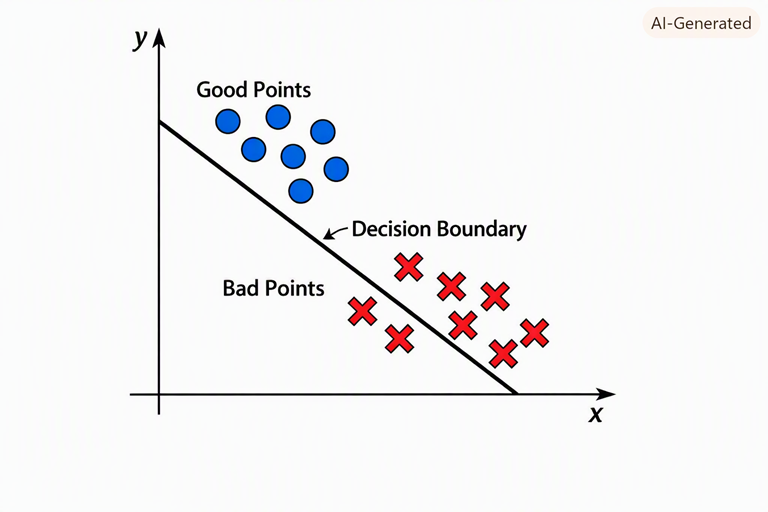
perceptron and implemented it in hardware. Given “good” points
(x_i,y_i) and “bad” points (x_j',y_j') find a line separating
them.
Good points, bad points
Minsky and Papert (1969)] set the
field back by showing a perceptron could not be trained on XOR.
It wasn’t until 1980-1995 that people realized you could solve this
with neural networks: layers of perceptron with output of each
layer providing input for the next. This is also when reinforcement
learning was developed.
From 1995-2012 statistical learning was developed:
Expectation Maximization, Hidden Markov Models, decision trees, random
forests, … Models were small and understandable.
The deep learning started in 2012 when Moore’s Law made
computing power and memory available. No new techniques were invented
until transformers(Vaswani et al. 2017) “Attention Is All
You Need.” It allowed models to run in parallel instead of
sequentially.
A large language model is a function and a context. Given a
sequence of characters it returns a sequence of characters. It takes
training data consisting of “correct” answers and interpolates.
So called “prompt engineering” is really about context
engineering.
The simple prompt “yes” will clue you in to the current context of
the LLM you are using at the moment. Use the output to detect what it is
not telling you.
Prompt from general to specific. You are looking for a needle in a
haystack.
DO NOT TRUST LLMs!
McCulloch, Warren S., and Walter Pitts. 1943. “A Logical Calculus
of the Ideas Immanent in Nervous Activity.”The Bulletin of
Mathematical Biophysics 5 (4): 115–33. https://doi.org/10.1007/BF02478259.
Minsky, Marvin, and Seymour Papert. 1969. Perceptrons.
Cambridge, MA: MIT Press.
Rosenblatt, Frank. 1958. “The Perceptron: A Probabilistic Model
for Information Storage and Organization in the Brain.”Psychological Review 65 (6): 386–408. https://doi.org/10.1037/h0042519.
Vaswani, Ashish, Noam Shazeer, Niki Parmar, Jakob Uszkoreit, Llion
Jones, Aidan N. Gomez, Łukasz Kaiser, and Illia Polosukhin. 2017.
“Attention Is All You Need.” In Advances in Neural
Information Processing Systems. Vol. 30. Curran Associates, Inc. https://arxiv.org/abs/1706.03762.